


| File Reference : | F-AI1 AI System Life Cycle |
| Date File Updated | 13-08-26 |
| File Format | MS Word |
| No. of files | 1 |
| Category | Form Templates | Tags: ISO 42001 |
Included in the alphaZ subscription
Every alphaZ document and toolkit, with updates as they are released. Everything you download is yours to keep.
Nine stages sounds like a lot until you fill one in. It is a single sheet per AI system, and most of what goes in it you already know - what you wanted the thing to do, who checked it, and what happens when you stop using it.
This form template is supplied in fully editable MS Word format and can be easily customised and edited. The document uses pre-defined style formatting throughout, with all text in Calibri font for improved readability.
The following document labelling is included in the footer:
- Form number and title
- Information-classification
- Version
- Page number / total pages

Further guidance on managing AI systems through their life cycle:

Download this form template with your company name and logo already added!
Document Preparation is included with the alphaZ subscription.
This file is included in the alphaZ subscription. This form is also included in the ISO 42001 Toolkit.

If you'd like hands-on help documenting the AI systems you already use, or setting up your wider AI management system, our remote support services provide direct expert input from our team, by the day, by project, or on an ongoing basis.

AI System Life Cycle Form Template
A one-page record of the criteria and requirements applied at each stage of an AI system's life, from the point someone decides it is needed through to the day it is switched off. One completed form per AI system.
ISO 42001:2023 expects an organisation to define and control the life cycle of the AI systems it develops or uses, and to keep documented information showing it has done so. This form is that documented information, in a format that takes minutes rather than an afternoon.
Built for ISO 42001
The nine topics follow the life cycle requirements of the standard and the supporting Annex A controls:
- Requirements and specification recorded before development or adoption, not after
- Verification and validation measures defined along with the criteria for their use
- Event logging decided per life cycle phase, with the documentation retained
- Closure treated as a controlled stage, covering data entered and data produced
What's Included in this AI System Life Cycle Form
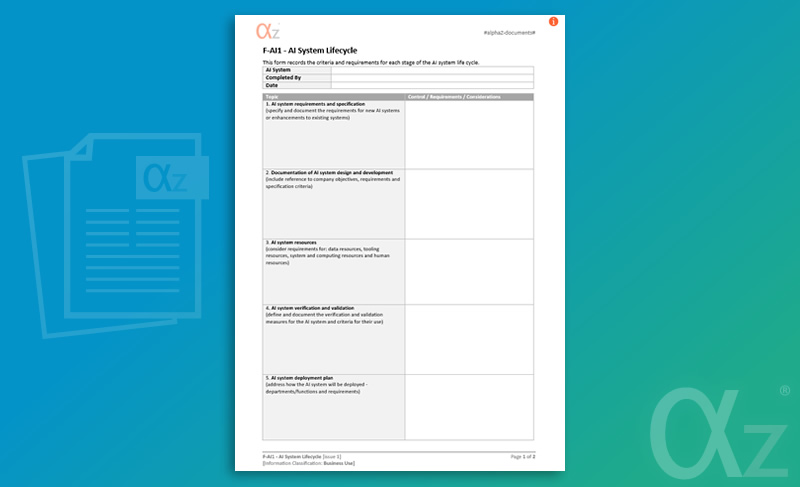
A header for the AI system, who completed it and the date, then nine numbered topics each with space for the controls, requirements and considerations that apply:
- 1. Requirements and specification - what the AI system is required to do, for new systems or enhancements to existing ones
- 2. Design and development documentation - referenced back to company objectives and the specification criteria
- 3. Resources - data, tooling, system and computing, and human resources
- 4. Verification and validation - the measures defined and the criteria for using them
- 5. Deployment plan - which departments and functions, and on what requirements
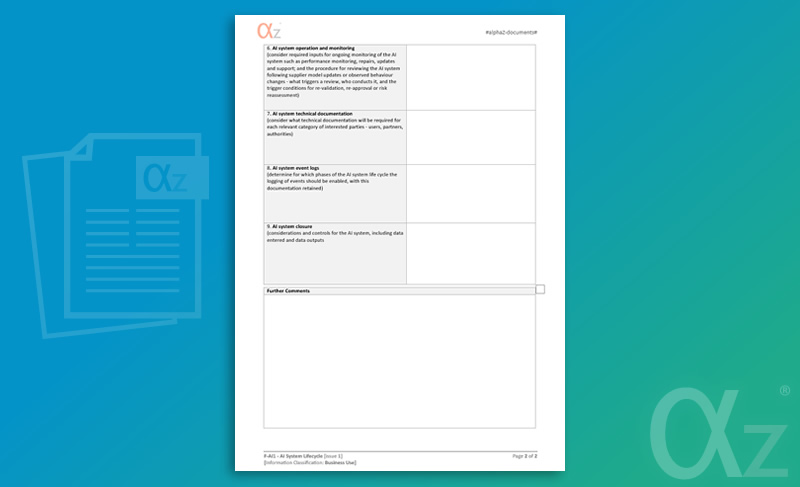
- 6. Operation and monitoring - performance monitoring, repairs, updates and support, plus what triggers a review after a supplier model update or a change in observed behaviour, and the conditions for re-validation or re-approval
- 7. Technical documentation - what each category of interested party needs, whether users, partners or authorities
- 8. Event logs - which life cycle phases have logging enabled, and how the records are retained
- 9. Closure - the controls applied at retirement, including data entered and data produced
A further comments box closes the form.
Who Needs an AI System Life Cycle Form?
Any organisation building AI into a product, or adopting an AI tool that will matter if it goes wrong. It is the record an assessor asks for when they want to see that an AI system was specified, checked and approved rather than simply switched on, and it is equally useful for answering the AI questions now appearing in customer due diligence.
Included in the ISO 42001 Toolkit
This form is part of the ISO 42001 Toolkit - the policies, procedures, registers, audit checklists and guidance for running an AI management system in one download. The other three AI forms are listed on the F-AI forms page.
Pairs with the AI Impact Assessment
The life cycle form records how a system is built and run. F-AI3 AI Impact Assessment records what it does to the people it affects, and the risks from both are held on the ER42 AI Risks and Controls Register.


